
Polycarbonate, Acrylic or Glass?

Choosing the right material for your display cover lens
Selecting the right substrate is one of the most important decisions when designing a cover lens for an electronic display.
Polycarbonate, acrylic (PMMA) and glass can all provide excellent solutions, but each offers different advantages. Impact resistance, optical clarity, scratch resistance, weight, UV exposure, chemical resistance and the operating environment can all influence the final material choice.
At Display Protect Solutions, we work with polymer and glass cover lens solutions, helping customers select materials and surface finishes around the requirements of the application.
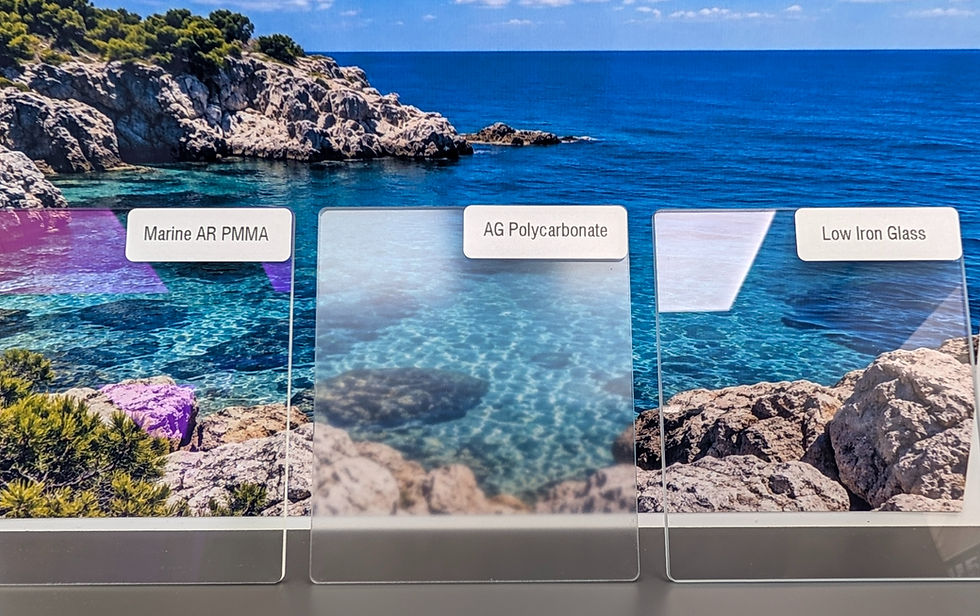
Polycarbonate — when durability matters
Polycarbonate is often the preferred choice where impact resistance and toughness are key requirements.
Its combination of low weight, high impact strength and excellent machinability makes it particularly suitable for rugged electronic equipment and applications where the cover lens may be exposed to mechanical impact or demanding operating conditions.
Typical advantages include:
Exceptional impact resistance
Lightweight construction
Excellent CNC machining characteristics
Wide range of hard-coated and optical finishes
Suitability for demanding environments
Polycarbonate is particularly well suited to industrial, transportation and portable electronic equipment.
Acrylic / PMMA — when optical clarity matters
Acrylic, commonly referred to as PMMA, combines excellent optical transmission with good inherent surface hardness and UV resistance.
Like polycarbonate, it is lightweight and can be precision machined, making it a useful alternative where optical appearance and outdoor stability are more important than maximum impact resistance.
Typical advantages include:
Excellent optical transmission
Good inherent surface hardness
Excellent UV and weathering resistance
Lightweight construction
Good machining characteristics
PMMA is particularly suitable for instrumentation, displays and applications requiring excellent optical appearance.
Glass — when optical and surface performance matter
Glass offers excellent optical properties combined with very high surface hardness, scratch resistance and strong chemical resistance.
It can also be supplied with specialist optical surface treatments, including anti-glare (AG) and anti-reflective (AR) finishes.
Typical advantages include:
Excellent optical clarity
Very high surface hardness
Excellent scratch resistance
Strong chemical resistance
AG and AR treatment options
Premium appearance and feel
Glass is particularly suited to high-end displays, touchscreens, medical equipment and demanding optical applications.
More than just the substrate
Selecting PC, PMMA or glass is only part of the specification.
The surface treatment can be equally important in determining how a cover lens performs in its final environment.
Depending on the application, options can include:
Clear hard coating
Anti-glare (AG)
Anti-reflective (AR)
ESD / anti-static surfaces
IR filtering
Anti-fingerprint finishes
Specialist hard coatings can also significantly improve the surface performance of polymer substrates, allowing PC and PMMA to be tailored to applications requiring improved scratch and abrasion resistance.
What about fire performance?
Where flammability requirements apply, the specific material grade also needs to be considered rather than simply choosing between PC and PMMA.
Flame-retardant polymer grades, including UL 94 rated materials, are available for applications where fire performance forms part of the product specification.
The right cover lens starts with the application
There is no single substrate that is best for every electronic display.
The right choice depends on the environment in which the product will operate and the balance required between impact resistance, optical performance, surface durability, weight, chemical resistance and environmental exposure.
Display Protect Solutions provides precision polymer and glass cover lens solutions for electronic displays — from material and optical finish selection through to manufacture, printing and integration.
Precision cover lenses. Engineered around your application.


Comments