
Anti-Glare vs Anti-Reflective — Not the Same Thing

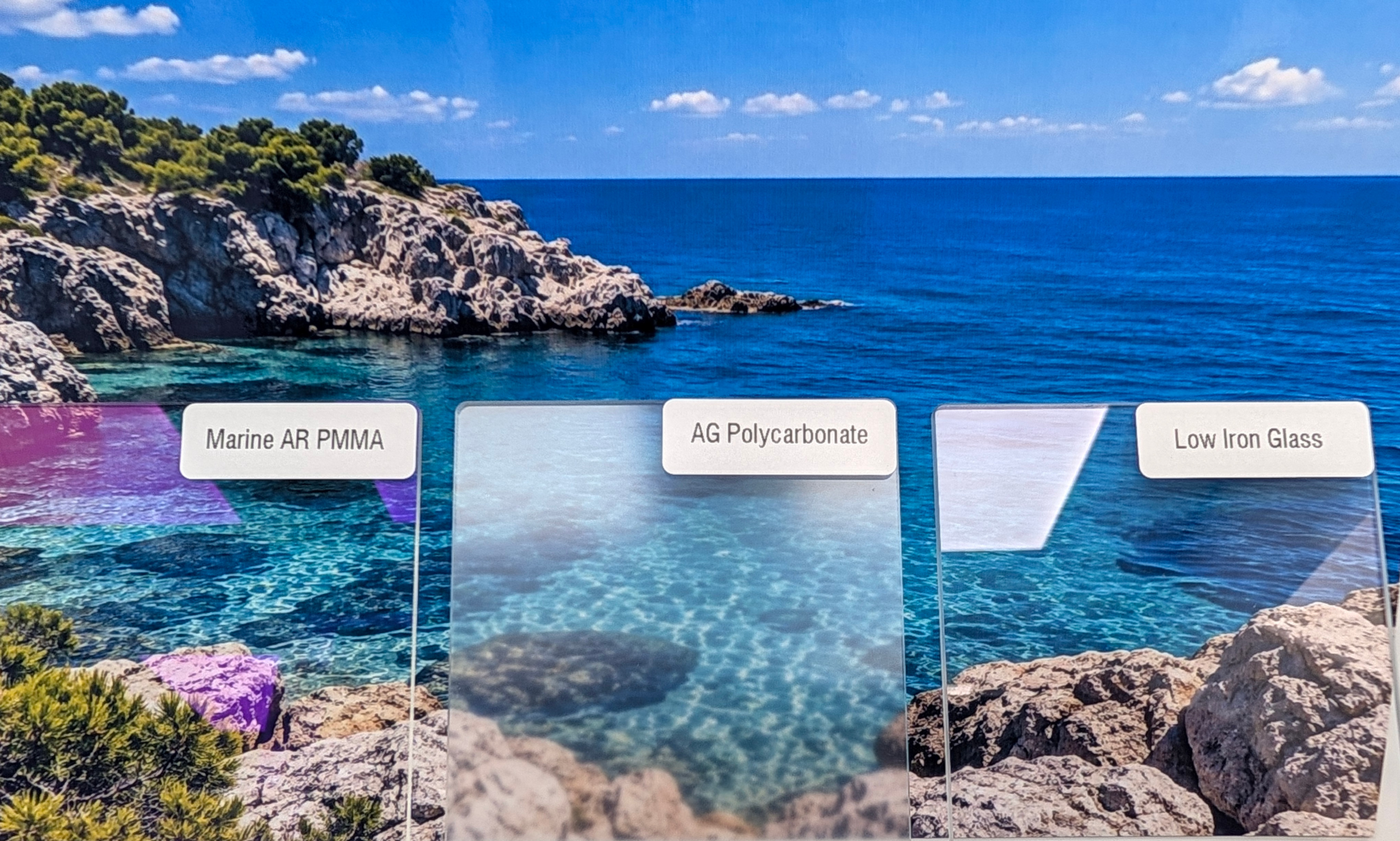
A common specification error
“AG/AR hard coated lens.”
This appears regularly on RFQs. It can represent a valid requirement for a combined optical treatment, but in other cases it is used as shorthand without clearly defining the required optical performance.
When comparing anti-glare vs anti-reflective cover lenses, it is important to understand that the two treatments solve different optical problems. They operate using different physical principles and produce different visual outcomes.
Specifying them interchangeably introduces performance risk.
Anti-Glare vs Anti-Reflective: The Engineering Difference
Anti-Glare (AG)
Anti-glare surfaces reduce visible reflections by diffusing reflected light.
This is typically achieved through:
Surface micro-texture
Silica-filled hard coat systems
Controlled matte topcoats
Result:
Reduced mirror-like reflections
Lower apparent gloss
Increased haze
Slight reduction in image sharpness
AG works by scattering light. It does not eliminate reflection — it redistributes it.
AG is often appropriate for:
Industrial HMIs
Harsh lighting environments
Applications where readability outweighs contrast precision
Anti-Reflective (AR)
Anti-reflective coatings reduce reflection through thin-film interference.
They are typically:
Vacuum deposited multi-layer systems
Optically tuned across a defined wavelength range
Optimised for visible light transmission
Result:
Increased light transmission
Improved contrast
Very low surface reflectance — potentially below 1%, depending on the coating system and measurement conditions
No intentional haze increase
AR works by cancelling reflected light waves, not scattering them.
AR is often appropriate for:
Automotive displays
Marine displays
Outdoor high-contrast applications
Optical or measurement systems
Premium consumer electronics
Where Confusion Happens
Common errors include:
Requesting “low reflection” without defining gloss or reflectance %
Specifying AG when contrast improvement is required
Ignoring haze impact on display clarity
Assuming AR can be achieved through matte coating
Not declaring lighting environment
AG and AR address reflections in different ways and should not be specified interchangeably. They can, however, be combined where an application requires both glare diffusion and reduced surface reflectance.
Property | Anti-Glare (AG) | Anti-Reflective (AR) |
Primary function | Diffuses reflections | Reduces reflections |
Principle | Light scattering | Thin-film interference |
Haze | Increased | Typically very low |
Image sharpness | Can be reduced | Largely maintained |
Surface appearance | Matte / textured | Clear / glossy |
Contrast | Can reduce apparent contrast | Can improve apparent contrast |
Typical use | Harsh/uncontrolled lighting | High-clarity/high-contrast displays |
Reflection control | Redistributes reflected light | Reduces reflected light |
Can AG and AR Be Combined?
Yes. Anti-glare and anti-reflective technologies address different aspects of reflected light and can be combined within a cover-lens solution. A combined AG/AR specification may be appropriate where both diffuse glare control and low surface reflectance are required. The optimum solution depends on factors including the display type, lighting environment, acceptable haze, target reflectance and required image clarity. DPS can offer combined AG/AR solutions across selected PMMA, polycarbonate and glass cover-lens materials, allowing optical performance to be matched more closely to the application.
Process and Validation Implications
For a finished display cover lens, optical performance depends on more than simply specifying “AG” or “AR”.
Key characteristics may include:
Haze and light transmission
Surface reflectance
Coating hardness and abrasion resistance
Coating adhesion
Chemical resistance
UV and environmental stability
Surface cleanliness and cosmetic quality
Processing must also be considered. CNC machining, screen printing, cleaning, handling, bonding and optical lamination all need to be compatible with the selected coated substrate.
The coating specification therefore needs to be considered as part of the complete cover-lens assembly — not as an isolated material property.
Practical Takeaway
Before specifying AG or AR, define:
Lighting conditions (indoor, outdoor, direct sun)
Acceptable haze %
Target reflectance %
Required abrasion durability
Environmental exposure requirements
If maximum image clarity and contrast are critical, AR will often be the preferred solution. Where glare reduction in uncontrolled lighting is the priority, AG may be more appropriate. Where both characteristics are important, a combined AG/AR solution should also be considered.
Optical performance begins with a clear problem definition — not a shorthand label.
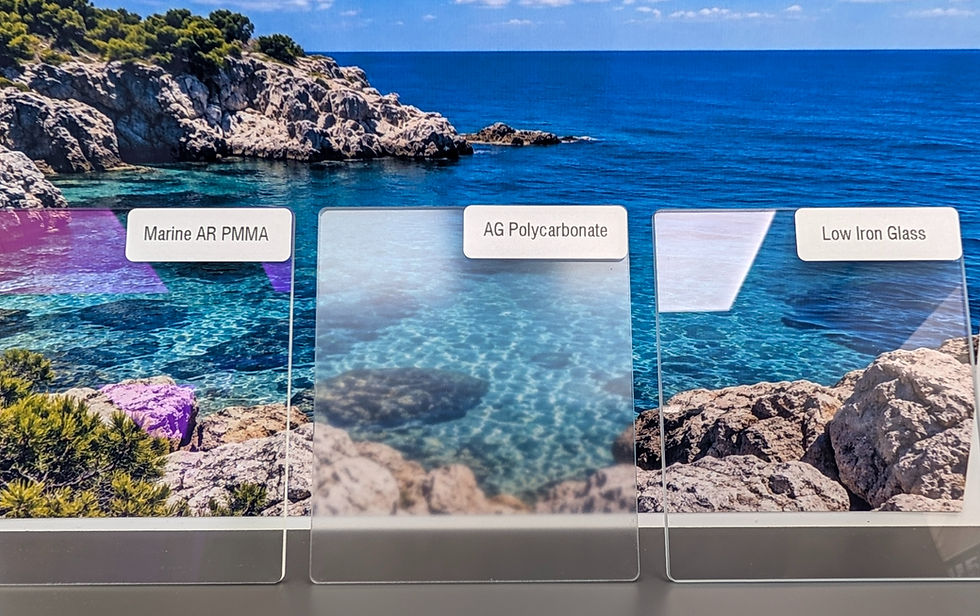
DPS supports engineers in selecting and evaluating AG and AR cover-lens materials across polycarbonate, PMMA and glass. Material samples are available to allow direct visual comparison before a substrate or coating specification is finalised.


Comments